The concept of Ki in Aikido, a literature survey
by Minhhuy Ho
Introduction:
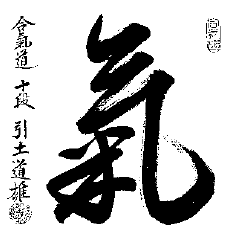
Ki
Ask a Chinese what is 'chi/qi' and you will get as many answers as you would asking an Aikidoka how to perform a kokyunage. A common answer is that chi refers to a particular mental and physical state that exhibits in a psychophysiological power associates with blood and breath. A chinese philosopher will talk about this microcosmical 'matter-energy' which is fundamental in forming and governing the universe. A traditional chinese physician, usually also a taoist by education, speaks about a microbiomaterial that circulates within the body, maintaining the living force that makes the body function. The chinese will probably accept any of these definitions in a 'matter-of-fact' manner and do not expect questions or disagreements concerning the meaning of chi. Of course this does not mean that they actually had a very accurate idea about the meaning of chi or that everybody knows exactly in what context one means when one talks about chi. In fact, the chinese probably means all of the above definitions, and more. This raises immediate problem for the western mind which makes clear distinctions between matter/mind, material/nonmaterial, physical/psychological/ physiological etc.. However one disagrees with the chinese blatant disregard for the cartesian dichotomy, this is in fact the way in which the chinese conceptualizes chi, or any other phenomena at all. Furthermore, they seems to be happy to trade off the analytical clarity for the imaginative richness.
When the chinese cosmic system which uses chi to explain the structure and function of virtually every phenomenon in the universe finally got transmitted to Japan in the seventh century, it had the shinto and tendai buddhist flavours added on. Unfortunately, or fortunately, the meaning of chi/ki did not get any clearer crossing the japanese sea. At any rate, from the oldest extant japanese work on traditional medicine, Ishopo by Tamba no Yasuyori, in the tenth century to modern works such as 'Qi: From the Analects to the New Science' by Maruyama Toshiaki, 'Qi: the Flowing body' by Harada Jiro one can see that both japanese and chinese traditional medicine share a basic conception of what it means to be fully human. Life is constituted by ki (in the sense of breath and energy), a force that manifests in respiration and that can be felt circulating within the body. Similarly, japanese drugs and
Akido, a japanese martial art developed by master Mohirei Ueshiba earlier this century makes heavy use of the concept of ki. Aikido is one of the more spiritual martial arts and has been considered as 'moving zen'. The name Aikido means 'the way of harmony of ki'. Just exactly what is this ki that one supposes to harmonize with is a controversial topic among Aikidoka's. Some believes that the physical entity ki simply does not exist. Instead, the spirit, the intention, the bio-physico-psychological coordination through relaxation and awareness are concepts being used in the teaching. These Aikidoka's sometime tend to frown upon the philosophical/spiritual aspect of ki. Other Aikidoka's believe that ki does exist as a physical entity and can be transmitted through space. They, on the other hand, make use of concepts such as ki of the universe, extending ki etc.. By citing these two extremes, the author does not wish to imply that the 'truth' lies somewhere in between. But the fact of the matter is that there is a large portion of Aikidoka who are still, and no doubt will continue be, on their 'quest for ki'.
The task is not simple since many sensei's are reluctant to talk about ki. Those who do, do it in a very oriental way: full of metaphor, image and lack of clarity. The aim of this article is surveying the writting and teaching of Kaiso, his deshi's: Ueshiba, Tohei, Yamada, Shioda, Saito, Saotome, Nadeau, Dobson, Homa ... (listed in no particular order) to find out what they did mean when they mentioned the concept ki, or to find out whether one can come up with a definite answer at all. For the sake of simplicity, let's propose three simple definitions of ki:
- Ki: the principle that governs the universe AND the individual, the cosmic truth.
- Ki: the action from a particular state of mind and body that can have physical/psychological/physiological effect. This ki can be expressed, and hence, perceived through physical apprearance, behaviour, and body language.
- Ki: similar to (2). However this ki can be expressed and perceived by means including but not limited to those listed in (2).
One can see that from (1) to (3) the degree of abstract decreases while the physical component increases. The meaning of ki of course is not limited by the individual or combined definitions mentioned above.
Writings and Teachings of Saito, Yamada, Shioda, Homma, Nadeau and Dobson:
Among the available Aikido literatures from Kaiso's deshi's, "Traditional Aikido" by Morihiro Saito sensei stands out as a classic. Nevertheless, in this five-volume work, the concept of ki is discussed only briefly: "Ki: the vital force of the body. Through Aikido training, the ki of a person can be drawn in increasing amount from the universe. In practice, ki is directed before body movement takes place." A short description of a series of exercises for ki flowing can be found in his later work "Aikido, its heart and appearance" where one "causes partner's ki to flow out (fluid)" and "calling out your partner's ki and linking it to yours". Yoshimitsu Yamada sensei, a marvelous Aikido technician, in "The New Aikido Complete" is even less specific about ki. He refers to ki as "the power of the spirit of the mind that we all possess but which we use only on rare occasion." There is no noticable mention of ki in the work of Gozo Shioda sensei, the founder of Yoshinkan Aikido.
These sensei's are accomplished Aikidoka's in every sense of the word. Saito sensei's profound knowledge about Aikido techniques especially his contribution to the jo, bokken kata's is well respected in Aikido and aiki-jitsu circles. Shioda sensei's flawless and spontaneous techniques can only be compared with the equilibrium and tranquility reflected in chinese landscape paintings. It is hardly possible that these masters, who studied with the master of ki himself, are ignorant of the importance of ki. One can hypothesize that these sensei's feel that the teaching of ki, whatever their definitions are, has no place in a technical manual and is best left unspoken. Andvanced students should experience and define the essence of the art themselves with the guidance of the sensei. This style of teaching, known as shinin (imprinting of the heart), is not foreign to the oriental. The saying "A special transmission outside the Scriptures, no dependence upon words and letters" sums up the fundamental of Zen teaching. As Shioda sensei wrote "They (martial arts) must not become mere intellectual exercises, the fundamental budo 'conduct' must not be treated lightly, and the 'way of technique' must not be neglected as a form of spiritual and physical training", he wished to emphasize the idea that the essence of Aikido - ki - would express itself to those who practice and follow basic techniques diligently. This sentiment seems also to be shared by Doshu in his interview with Stan Prannin.
The sincere and direct approach in "Aikido for Life" has made Homma sensei's book an excellent introduction to what it takes and what it tastes like to be an Aikidoka. Aikido for Life is not a technical manual per se, albeit several techniques and exercises were included, but rather a reflection on the physical and mental training process of Aikido. Homma sensei's book reflects his honest feeling about the art and the way it should be practiced. He performed an irimi to many conceptions and misconceptions in Aikido. Homma sensei devoted the whole second chapter to the discussion of ki, which he believes does not exist. "The word ki is made of two letters, 'k' and 'i' nothing more. Of course you know how difficult it is to undestand something that can only be imagined. Some try to describe this thing that doesn't exist by letting their explanations drift into the realm of mystery. The mystery of ki has been deceiving many students"
To Homma sensei, ki has no color, shape nor weight and cannot be shown by ki believer simply due to the fact that ki as a physical entity does not exist. Homma sensei himself however, does not come up with the definition of ki himself as it seems not to be within the scope of his book. Instead, he urges one to dicsover ki "through daily practice inside and outside the dojo" but not "adopting another's definition blindly." Aikido according to Homma sensei is the "training of the mind" which expresses itself through breathing. When one's mind, body movement, and breathing is in harmony with the surroundings, one experiences the true meaning of Aiki. In this aspect, Homma sensei's concept of ki seems to be similar to definition (2) mentioned above. Homma sensei credits several technical accomplishments such as 'unbendable arm', 'unliftable body' to consistent practice and rejects the contribution of the "mysterious power" of ki. However, he also credits the benefits of several Aikido exercises, such as nikkyo and kotegeashi wrist warm up, and practices such as open hand, back rolles to shiatsu (acupressure). This seems somewhat contradictory. The concepts of keiraku (chinese: jingluo, english: meridian), rokuzo (liuzang, six yin organs), roppu (liufu, six yang organs) mentioned in Homma sensei's book are those discovered/invented by chinese traditional medicine. From this perspective, shiatsu inherited its entire theoretical foundation from acupuncture. The concepts of channels existing in human (and animal) body and their associated ying and yang organs (which do not necessarily have the equivalence in western medicine) are unique to chinese traditional medicine. Their sole purpose is to circulate chi within the body. The chi mentioned here is a physical entity as defined earlier according to chinese traditional medicine. One cannot use these concepts without accepting their raison d'e^tre. It seems that Homma sensei has denied the existence of the physical aspect of ki in one context only to use it in another.
Among O sensei's first american deshi is Robert Nadeau sensei who came to study with the master in his late seventies. Nadeau sensei, being profficient in several martial arts, has profound impact on his students not only thought his super physical techniques but also his dynamic approach by way of harmoninzing physical and mental concepts, action and comtemplation. Since there is no literature available by Nadeau sensei, his teaching will be extracted from the works of two of his decorated deshi's : Richard Strozzi Heckler and George Leonard.
In "The Ultimate Athelete", Leonard sensei describes a typical Energy-Body workshop pioneered by Nadeau sensei. The workshop begins with the assumption that "a field of energy exists in and around each human body". This energy is ki, "a single manifestation that includes emanations that can be measured by our present science, plus other esoteric or metaphorical amanations". One of the exercise in the workshop is "sensing the energy body" where partners stand with arms extending towards each other. When one 'feels' the energy from one's partner, one is asked to move apart to find out how far away one can still sense the energy connection. It is also obvious from other exercises that Nadeau sensei's idea of ki includes definitions (2) and (3).
"The Anatomy of Changes" by Heckler sensei portrays his effort to utilize Aikido principles in psychotherapy. The book describes the hara as "a point two inches below the navel, as the center of gravity and the place where ki (or life energy) originates". One can "feel or imagine a warmth in this area" to center oneself. To "ground" oneself (feel the connection between the body and the ground), one extends ki by feeling or imagining one's energy as "a strong flowing current that moves from your belly through your pelvis and legs, deep into the earth". Similarly, "unbendable arm" is done by feeling or imagining that "a current of powerful energy flowing through and out of this arm for a distance of a thousand miles. Your arm is like a conduit for a limitless and far-reaching energy that effortlessly flows through it. When you start to feel tingling, vibrating, or streaming sensations in your body and arms, continue to relax, and allows these sensations to join the current that is flowing through your arm". Again, this way of conceptualizing ki has more overlap with definition (3) than (2).
Terry Dobson sensei received the mission from O sensei to spread the spirit of Aikido to his people when he was one of Kaiso's last uchi deshi's. His life was the proof for the fulfillment of that promise as he refers to himself as a "ki mechanic". His only written work left is "Aikido in Everyday Life" though he has "imprinted the hearts" of many by his teaching. In "Aikido in Everyday Life" Dobson sensei refers to the one point "where one should be living ... it is the 'organ' which can sense attack faster than the intellect." This one point, according to Dobson sensei, is the protective spirit, ki, which is employed in unraisable body exercise. But ki also is one's "connection to all life, time, and space; nowness; and energy". Throughout his life, Dobson sensei has been the mechanic for a more down-to-earth kind of ki. "Aikido in Everyday Life" was written to solve life conflicts by Aikido techniques. As he wrote "It is possible for a liar or a cheat to use Aiki or any of otherfive attacks to responses and aim for a 'kill' or a 'win' over somebody who has made the mistake of attacking him. But strange things begin to happen to people who become involved with Attack-tics ... even the most mean spirited of people begin to relinquish their grasp on their aggression, lose their anger, and reconnect with the living force". From his well known story "A Kind Word Turneth Away Wrath", one can see that the essence of Aikido according to Dobson sensei has a strong social implication. It seems that Dobson sensei's concept of ki covers all three definitions mentioned above.
References:
W.-T. Chan, A Source Book in Chinese Philosophy, Princeton University Press,
1973.
Y.-L. Fung, A Short History of Chinese Philosophy, McMillan Press, 1966.
T. J. Kaptchuk, The Web that has no Weaver. Understanding Chinese Medicine,
Congdon and Weed, New York, 1983.
W.-M. Tu, Confucian Thought, State University of New York Press, 1985.
S.-C. Huang, Chang Tsai's concept of Chi, Philosophy East and West, vol. 18,
pp. 247, 1968.
Y. S. Kim, The Concept of Chi in Chu Hsi's philosophy, Philosophy East and
West, vol. 34, 1984.
Y. Sakade, Longevity Techniques in Japan. Ancient Source and Contemporary
Studies, in Taoist Meditation and Longevity Techniques, Eds. L. Kohn and Y.
Sakade, Center for Chinese Studies, The University of Michigan, 1989.
Morihiro Saito, Traditional Aikido, vol I-V, Minato Research and
Publications 1974.
Morihiro Saito, Aikido, its Heart and Appearance, Minato Research and
Publications 1975.
Yoshimitsu Yamada, The New Aikido Complete, Carol Publishing Group 1981
Gozo Shioda, Dynamic Aikido, Kodansha Publishing 1968. Translator: Hamilton
Jeffrey.
Stan Prannin in Aikido and the New Warrior, Eds. Richard Heckler and Goerge
Leonard, North Atlantic Books 1990.
The Academy of Traditional Chinese Medicine, An Outline of Chinese
Acupuncture, Foreign Langauges Press, 1975.
Felix Mann, Acupuncture. The Ancient Chinese Art of Healing and How it Works
Scientifically, Vintage Books 1973.
Shizuto Masunaga with Wataru Ohashi, Zen and Shiatsu. How to Harmonize Yin
and Yang for Better Health, Japan Publication 1977.
Toru Namikoshi, Shiatsu and Stretching, Japan Publication 1985.
George Leonard, The Ultimate Athelete. Revising Sports, Physical Education
and the Body, The Viking Press 1975.
Richard Strozzi Heckler, The Anatomy of Change. East/West Approaches to
Body/Mind Therapy, Shambhala Publication 1985.
Terry Dobson and Victor Miller, Aikido in Everyday Life, North Atlantic
Books 1983.
Aikido Today Magazine, The Journal of the Martial Arts and Spiritual
Discipline of Aikido, #25, vol. 6 1992/1993.